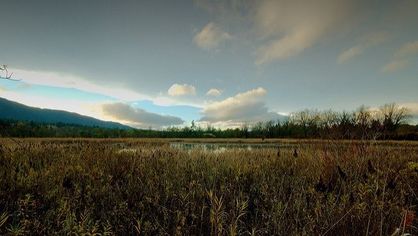
Coastal wetlands, like this tidal marsh, are not only beautiful, they are also home to diverse ecosystems and act as protective buffers between coastal communities and the sometimes stormy and destructive ocean. Worryingly, sea-level rise and bigger storms threaten to flood and erode these vital environments as climate change worsens. One method that has been proposed to save coastal wetlands is to apply a thin layer of sand to the top of drowning marshlands so that they can keep up with sea-level rise and withstand powerful storms. But before we can take this approach, scientists had to prove that it works – that it can build up the elevation of the marsh without harming the marsh plants. Scientists from the EPA and the University of South Carolina set out to do just that. They looked at the roots of two different sets of marsh grasses, some that had been left untampered with (“natural soil”) and others that had been supported with a thin layer of sand (“soil-amended”). And what did they find? Just look at this picture of some of the roots. The two groups had the same amount of roots after the end of the growing season, meaning that they both grew the same amount! There were differences between them (like nutrients, pH, and salinity of the water near the roots as well as the shape of the roots), but these variances didn’t much affect the root growth. This is a big deal in the coastal management world! The growth of roots, called belowground productivity, is vital to the success of coastal wetlands. Growing roots support the buildup of organic matter and peat in marshes, ultimately building the marsh’s elevation, and helps wetlands keep up with more future flooding. So, the method of applying a thin layer of sand to marshlands, especially those that may not have enough natural sediment, can boost coastal resiliency to climate change and help save these beautiful and bountiful ecosystems. 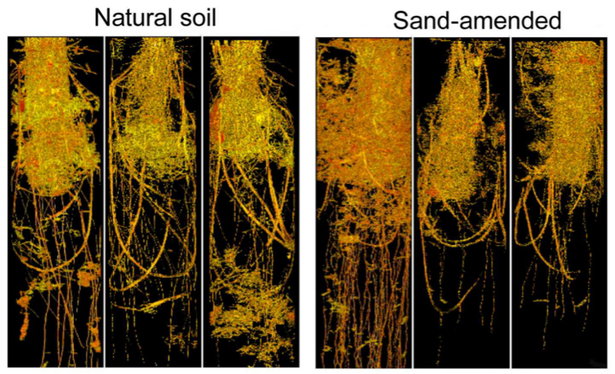 Original article and figure can be found:
Wigand C, Sundberg K, Hanson A, Davey E, Johnson R, Watson E, et al. (2016) Varying Inundation Regimes Differentially Affect Natural and Sand-Amended Marsh Sediments. PLoS ONE 11(10): e0164956. doi:10.1371/journal.pone.0164956 Can't access the original article? Find out more details about this article on our database: http://www.opensciencedb.com/federal-agency-research-db.html#federal-research-db/medical-research-db-detail/58c89c374096c02a30e902a8/ Picture of the open field is from Flicker https://www.flickr.com/photos/wavesummit/ |


|
|
